


A Houthi missile assault leaves 53 soldiers dead in Shabwa, US Defence Secretary Pete Hegseth visits regional forces unannounced, and Tehran moves against international shipping channels.
DUBAI, Oct. 20, 2026 —A series of rapid military escalations pushed the Middle East deeper into conflict on Tuesday, marked by a devastating Houthi ballistic missile barrage in southern Yemen that killed at least 53 soldiers, mounting disruption along Gulf maritime corridors, and an unannounced tour of the region by US Defence Secretary Pete Hegseth.

The deadly strike targeted a military training installation in Yemen’s southern Shabwa province, leaving more than 200 recruits wounded, according to provincial authorities and military commanders. The assault ranks among the bloodiest single strikes since ground hostilities flared across Yemen earlier this year, shattering a fragile truce established in 2022 and intensifying pressure on regional security frameworks.



Air defenses across the Arabian Peninsula remain on heightened alert following repeated cross-border projectile launches. In Saudi Arabia, authorities maintained disruptions around Riyadh’s primary international gateway following recent strikes, prompting US diplomatic posts in the kingdom to instruct citizens to heed civil defense guidance and shelter protocols.
Against this backdrop, US Defence Secretary Pete Hegseth arrived in the region on an unannounced visit to inspect forces under US Central Command (CENTCOM). Hegseth confirmed the deployment on social media, describing service members as engaged in a critical operational mission across the theater.
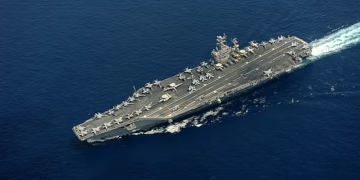
At sea, operational command on the aircraft carrier USS George Washington reported that multiple Iranian attempts to strike US vessels operating near the Strait of Hormuz were intercepted or failed without inflicting damage.
The maritime corridor remains a severe friction point. Iranian maritime regulators under the Persian Gulf Strait Authority published updated compliance tallies on Tuesday, stating they had blacklisted 122 commercial vessels and executed enforcement actions against more than 40 ships for alleged waterway violations. Around 30 additional vessels face blacklisting if warning notices are ignored.
Diplomatic maneuvering has quickened alongside the military exchanges. Beijing and Moscow reiterated public backing for Tehran, condemning recent US and allied actions as destabilizing aggression. Within Tehran itself, political discourse has increasingly shifted toward whether the state should revise its long-standing strategic doctrine to pursue operational nuclear weapons capability, even as regional leaders urge an immediate halt to cross-border strikes.