

Capt. Nicholas DeLeo confirms carrier strike group intercepted multiple drone and missile threats targeting regional naval and commercial vessels.
MANAMA, Bahrain —Iranian attempts to target ships operating near the strategic Strait of Hormuz have failed due to continuous defensive and offensive countermeasures by American naval personnel, the commanding officer of the aircraft carrier USS George Washington confirmed.
Speaking to journalists during an operational briefing aboard the nuclear-powered supercarrier in the US Fifth Fleet area of operations, Capt. Nicholas DeLeo said Iranian forces had launched attacks against “a variety of ships” in adjacent waterways, but confirmed zero successful impacts.


“Those have all been unsuccessful, and I can tell you that reason is 100% due to our sailors on this ship,” Capt. DeLeo said, highlighting round-the-clock combat readiness against persistent unmanned aerial vehicles (drones) and anti-ship missile systems.


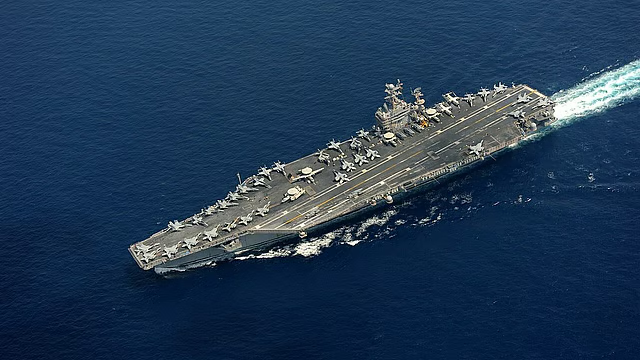
The Nimitz-class aircraft carrier USS George Washington (CVN-73) is deployed in the Arabian Sea alongside units operating near the entrance to the Persian Gulf. Its mission centers on safeguarding critical international shipping corridors, escorting commercial maritime traffic, and enforcing operational restrictions aimed at deterring hostile regional activity.
The carrier leads Carrier Strike Group operations alongside Carrier Air Wing 5 (CVW-5). Supporting escorts in the theater include guided-missile destroyers USS Shoup (DDG-86) and USS Benfold (DDG-65), along with the guided-missile cruiser USS Robert Smalls. Together, the group maintains a multi-layered radar, air-defense, and electronic warfare envelope capable of engaging aerial, surface, and sub-surface threats simultaneously.
Capt. DeLeo’s remarks reflect an expanded threat profile along the world’s most sensitive maritime energy chokepoint. While Tehran has historically relied on fast-attack craft and asymmetric naval mining, recent engagements have centered on synchronized drone swarms and anti-ship ballistic and cruise missiles.
Commissioned in 1992 after construction by Newport News Shipbuilding (now Huntington Ingalls Industries), the 100,000-ton supercarrier operates two nuclear reactors, enabling indefinite high-speed transit without refueling. The vessel carries more than 4,500 personnel and an air wing capable of launching up to 90 aircraft, primarily F/A-18E/F Super Hornets, EA-18G Growlers, and E-2D Advanced Hawkeye airborne early warning planes.
U.S. Fifth Fleet officials in Bahrain maintain that naval assets deployed across the Arabian Gulf, Gulf of Oman, and Red Sea will continue freedom-of-navigation missions, despite repeated attempts by Iranian forces to disrupt regional maritime security.