


Rescuers battle transport disruptions to deliver emergency aid to displaced families across East Nusa Tenggara after consecutive quakes devastate coastal infrastructure.
JAKARTA — Emergency response teams in eastern Indonesia faced compounded operational hurdles on Monday following a magnitude 5.9 earthquake that hit the Flores region, just days after a powerful 7.7-magnitude quake devastated parts of East Nusa Tenggara province, raising the confirmed death toll to 54.
The latest tremor struck at a shallow depth of 10 kilometers, according to data from the German Research Centre for Geosciences (GFZ). The epicenter was registered at 8.57 degrees south latitude and 121.55 degrees east longitude. The update follows a catastrophic series of seismic events over the weekend, which triggered temporary tsunami warnings and damaged critical civil infrastructure across six coastal regencies on Flores Island.


Indonesia’s National Disaster Management Agency (BNPB) confirmed that search and rescue operations remain active as medical personnel provide emergency treatment to hundreds of injured survivors. More than 12,000 residents have been displaced, with temporary shelters erected to accommodate families whose homes were leveled or declared structurally unsafe.


“Rescue efforts and supply lines are being prioritized for hard-to-reach zones,” stated BNPB Chief Suharyanto during an operational update. “We are utilizing integrated land, sea, and air routes to ensure relief reaches isolated communities.”
Air force units deployed 11 aircraft and heavy-lift helicopters to drop essential supplies into remote regions, including Palue Island in Sikka Regency, where ground access remains cut off. In Jakarta, President Prabowo Subianto inspected the initial dispatch of emergency aid from Halim Perdanakusuma Air Force Base, overseeing an airlift operation tasked with delivering 275 tonnes of relief supplies packaged into 50,000 emergency kits.
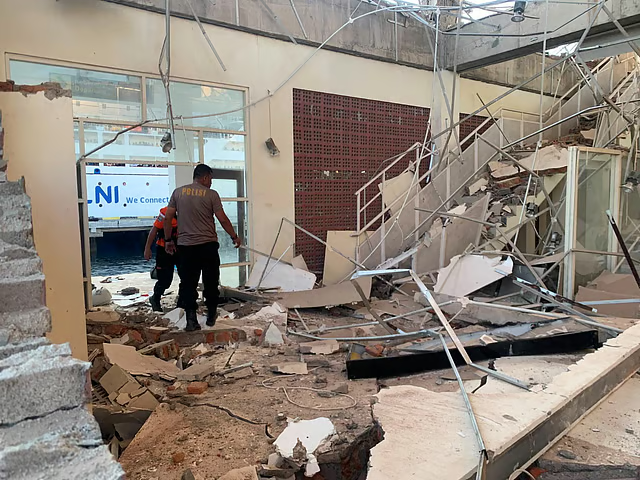
Structural assessments released by the BNPB indicate severe damage to local infrastructure. At least 157 homes have been completely destroyed, with another 189 sustaining moderate to light damage. The quakes also damaged key civic facilities, including 87 educational institutions, 18 health centers, six local administration offices, and five places of worship.
Medical operations in Manggarai Regency were severely compromised after the local regional hospital suffered structural integrity failures, forcing authorities to construct a temporary field hospital inside Golo Dukal Stadium to treat incoming casualties.
Indonesia’s Meteorology, Climatology, and Geophysics Agency (BMKG) noted that aftershocks are expected to continue in the coming days. A tsunami warning issued immediately following the initial 7.7-magnitude event was subsequently lifted after coastal sensors confirmed no dangerous rise in sea levels.