

Washington ramps up sanctions enforcement against Iranian financial networks while CENTCOM confirms crude tankers continue transiting the strategic shipping lane.
WASHINGTON / DUBAI — October 16, 2026 : The United States military has firmly rejected Iranian declarations that the Strait of Hormuz has been shut to international shipping, confirming that commercial vessels and crude carriers continue to transit the vital chokepoint under allied naval watch amid escalating confrontations in regional waters.

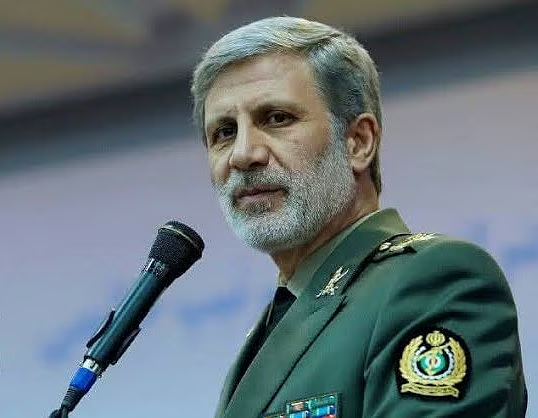
The denial follows public claims by senior Iranian military commanders asserting that Tehran had established complete control over the strategic corridor linking the Persian Gulf to the Gulf of Oman. Iranian Army Chief Major General Amir Hatami asserted in Tehran that the waterway would remain closed until Iran’s demands were met, insisting that no hostile ships had entered regional waters under naval watch.
United States Central Command (CENTCOM) disputed Tehran’s assertions, calling them groundless claims of maritime dominance. Military officials confirmed that coalition forces, operating alongside regional security partners, facilitated the passage of more than 19 million barrels of crude oil within a 24-hour window, maintaining deterrence against persistent interference from the Islamic Revolutionary Guard Corps (IRGC).


CENTCOM similarly dismissed Iranian assertions that a Singapore-flagged container vessel had been sunk by a naval mine near the strait, alongside unverified claims of coalition casualties in neighboring Jordan. US defense officials acknowledged the destruction of an Iranian-linked dhow operating suspiciously near international shipping lanes, confirming the crew was safely evacuated prior to the vessel’s disposal.
Diplomatic and financial pressure from Washington escalated concurrently. US Treasury Secretary Scott Bessent announced an expansion of targeted enforcement under the administration’s “Operation Economic Outcast” framework. The enforcement measures penalize financial networks, shadow-banking conduits, and overseas exchange houses operating across Iraq and Asia, which officials allege channel hundreds of millions of dollars toward Tehran’s defense apparatus.

Energy markets absorbed the heightened rhetoric cautiously. Global benchmark Brent crude held steady above $105 per barrel in early trading, moderating slightly following talks among consuming nations regarding potential releases from strategic petroleum reserves to counter Middle Eastern supply anxieties.
Diplomatic friction also widened across international capitals. Iran’s Foreign Ministry exchanged sharp rebukes with the United Kingdom following British allegations implicating Tehran in a disrupted security plot near RAF Fairford in Gloucestershire. Iranian officials denied involvement, summoning British Ambassador Hugo Shorter to deliver a formal diplomatic protest. Tehran simultaneously issued a sharp rebuke to Colombia following Bogota’s formal relocation of its diplomatic mission to Jerusalem, characterizing the shift as contrary to United Nations resolutions.