

Global markets on edge as US President seeks trade breakthroughs in Beijing amidst Middle East escalation and a tightening naval blockade on Iran.
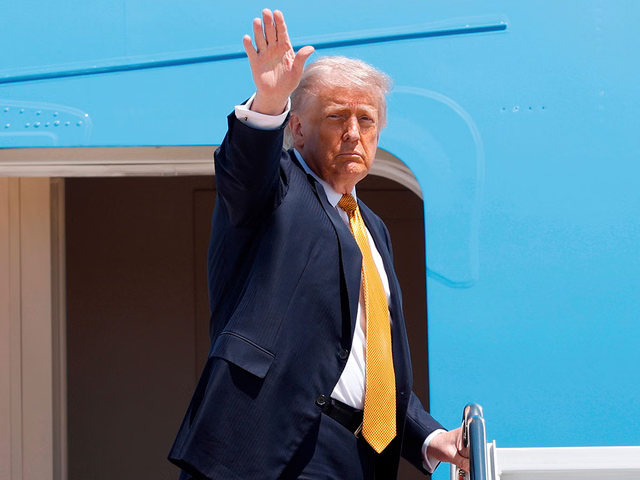
BEIJING – US President Donald Trump arrived in the Chinese capital on Wednesday for a high-stakes summit with President Xi Jinping, marking the first visit by an American leader to China in nearly a decade. The visit comes at a precarious moment for the global economy, as the Pentagon reveals that the ongoing conflict with Iran has already cost the United States approximately $29 billion and claimed the lives of 13 US service members.
The summit, originally delayed from March due to the outbreak of hostilities in the Middle East, is expected to focus on trade, the global AI race, and Iran’s role as a major energy supplier to China. Accompanied by tech titans including Nvidia’s Jensen Huang and Tesla’s Elon Musk, Trump signaled his intent to pressure Beijing to “open up” its markets, even as he seeks Xi’s cooperation in managing the volatile situation in the Persian Gulf.
Escalation in the Gulf: Blockades and Tensions
While diplomatic efforts continue in Beijing, the situation on the ground remains combustible. US Central Command confirmed on Wednesday that a naval blockade on Iranian ports is being strictly enforced. To date, US forces have redirected 67 commercial vessels and disabled four others accused of breaching the blockade.



In response, Tehran has asserted its control over the Strait of Hormuz, a vital artery through which a fifth of the world’s oil and LNG shipments typically pass. Iranian military spokesman Mohammad Akraminia stated that oversight of the waterway would generate “significant” revenue for the Islamic Republic, further complicating international efforts to stabilize energy prices.
Ceasefire Under Strain in Lebanon
Despite a fragile truce established in April, the region continues to witness bloodshed. In Lebanon, the Ministry of Health reported that Israeli airstrikes killed at least 12 people on Wednesday, including two children. The strikes targeted vehicles on the coastal highway south of Beirut, near the towns of Barja and Jiyeh.
Reports indicate that more than 10,000 homes have been destroyed or damaged in Lebanon since the ceasefire began. These latest attacks occur on the eve of US-brokered direct negotiations between Lebanon and Israel in Washington—a move that Hezbollah remains staunchly opposed to.
Economic Ripples: From Djerba to New Delhi
The far-reaching consequences of the conflict are being felt globally:
- Travel & Tourism: In Tunisia, hotel reservations have plummeted by 50% as skyrocketing oil prices drive up airfares.
- Aviation: Philippine Airlines has extended the suspension of flights to Dubai and Doha until August, citing “unpredictable airspace conditions.”
- Commodities: India has hiked import duties on gold and silver to protect a sliding rupee, while the International Energy Agency (IEA) warned that nations are drawing down strategic oil reserves at a “record pace.”
The Diplomatic Path Forward
In a significant diplomatic move, China’s Foreign Minister Wang Yi has urged Pakistan to intensify its role as a mediator between Washington and Tehran. Pakistan has emerged as a key intermediary in the effort to reopen the Strait of Hormuz and finalize a lasting peace agreement.

However, President Trump remains firm in his “maximum pressure” campaign. Speaking before his departure for Beijing, Trump reiterated his primary objective: “We cannot let Iran have a nuclear weapon. We have a blockade which allows them no money.”
As the leaders of the world’s two largest economies meet in Beijing, the global community remains watchful. The outcome of these talks may determine whether the current ceasefire evolves into a stable peace or if the region—and the global economy—faces further destabilization.