

The billionaire demands OpenAI return to its nonprofit roots, accusing CEO Sam Altman of betraying the company’s original humanitarian mission.
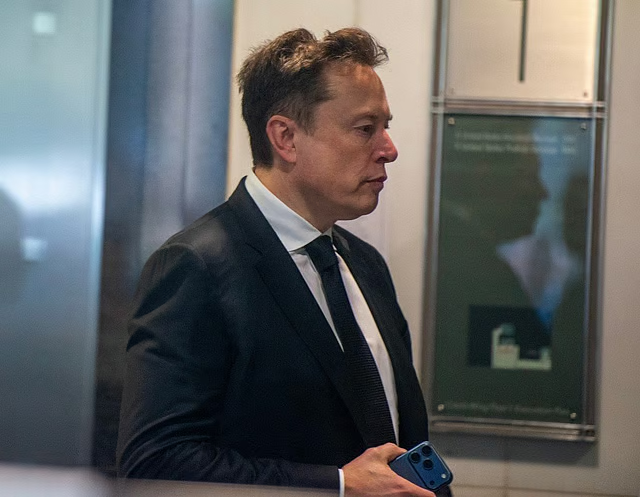
OAKLAND – In a high-stakes legal battle that could redefine the future of the artificial intelligence industry, Elon Musk took the witness stand on Tuesday to testify against OpenAI, the company he co-founded. Facing off against CEO Sam Altman in a federal court in Oakland, Musk alleged that the ChatGPT creator has been transformed into a “profit-seeking juggernaut,” abandoning the altruistic principles upon which it was established.
A Battle Over Ethics and Profit
At the core of the lawsuit is Musk’s contention that OpenAI breached its founding agreement to remain a nonprofit research lab. Musk, who was the trial’s first witness, expressed grave concerns regarding the precedent this case might set for charitable organizations in the United States.


“If a verdict comes up that effectively makes it okay to loot a charity, the entire foundation of charitable giving in America will be destroyed,” Musk stated during his testimony. He argued that his initial funding—totaling at least $38 million—was provided under the explicit understanding that the technology developed would be open-source and prioritize societal good over corporate gain.

The Shift to Commercial Powerhouse
OpenAI, founded in 2015 by Musk, Altman, and others, established a commercial subsidiary in 2019, a year after Musk’s departure. Since then, the company has secured a $13 billion investment from Microsoft, a stake now estimated to be worth $135 billion.
Musk testified that he was instrumental in the company’s early success, citing his role in recruiting top engineers from Google and leveraging his industry clout to secure partnerships with Nvidia and Microsoft—doors he claimed would have remained closed to the other co-founders at the time.

OpenAI’s Defense: Evolution as Necessity
Representing OpenAI, lead attorney William Savitt countered that the shift toward a commercial model was a financial necessity. He argued that the astronomical costs associated with developing cutting-edge AI required significant outside investment. Savitt further suggested that Musk’s legal action is fueled by personal regret over leaving the project before its valuation skyrocketed to its current $852 billion.
The defense maintains that the OpenAI nonprofit arm still retains ultimate control over the organization, despite its massive commercial success and impending high-profile IPO.
Industry Implications
The trial, presided over by Judge Yvonne Gonzalez Rogers, is being watched closely by Silicon Valley and global investors. Musk is not only seeking to force OpenAI back into a pure nonprofit status but is also calling for the removal of Sam Altman and President Greg Brockman.
While Musk has sought damages as high as $134 billion, he clarified in court that he has renounced any personal financial gain, pledging to redirect any awarded funds back into the OpenAI nonprofit foundation.
As the AI sector continues its rapid expansion, the court’s decision—expected by late May—will determine whether a startup can legally pivot from a charitable mission to a multi-billion dollar commercial enterprise.