

As President Trump awaits a response to his peace proposal, the Revolutionary Guards warn of “heavy attacks” on American regional centers following a maritime blockade.
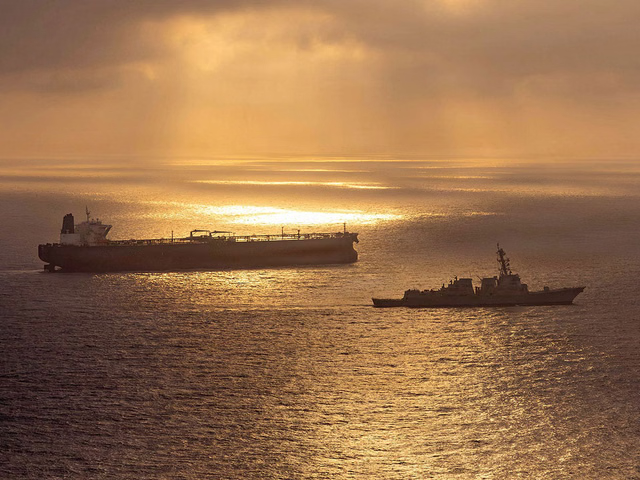
DUBAI/WASHINGTON – Tensions in the Middle East reached a precarious flashpoint on Saturday as Iran’s Islamic Revolutionary Guard Corps (IRGC) issued a direct threat to target United States military sites across the region. The warning follows a high-stakes naval confrontation in the Gulf of Oman, where US forces disabled two Iranian-flagged tankers, complicating a delicate diplomatic push for peace led by the Trump administration.
Naval Confrontation Sparks Retaliation Threats
The escalation began after US Central Command (CENTCOM) confirmed that the Arleigh Burke-class destroyer USS Rafael Peralta successfully implemented a blockade, disabling the Iranian tankers M/T Sea Star III and M/T Sevda. Washington described the move as part of ongoing enforcement measures against Tehran.
In a swift and blunt response, the IRGC stated via Iranian state media:


“Any attack on Iranian tankers and commercial vessels will result in a heavy attack on one of the American centers in the region and enemy ships.”
The timing of the threat is critical. US President Donald Trump had publicly stated he expected a formal response from Tehran regarding a new peace proposal by Friday night. However, as of Saturday, no such response has been made public, with Iranian Foreign Minister Abbas Araghchi questioning Washington’s “seriousness” in the wake of the naval strikes.

High-Level Diplomacy in Miami and the Gulf
Amid the military posturing, diplomatic channels remain active but strained. US Secretary of State Marco Rubio met with Qatari Prime Minister Sheikh Mohammed bin Abdulrahman Al Thani in Miami. Qatar continues to act as the primary interlocutor between Washington and Tehran.
Concurrently, regional heavyweights Saudi Arabia and Qatar held high-level discussions via telephone to coordinate de-escalation efforts. Qatari officials emphasized that a lasting solution depends on addressing the “root causes of the crisis” rather than military enforcement.

Russia’s Nuclear “Olive Branch”
Adding another layer to the geopolitical puzzle, Russian President Vladimir Putin has renewed an offer to store and manage Iran’s enriched uranium. Putin suggested that shifting the material to a “friendly country” like Russia under IAEA supervision could alleviate Western fears of weaponization.
“Our offers are still on the table,” Putin remarked, positioned as a potential mediator to break the nuclear deadlock that remains central to the broader US-Iran conflict.
Lebanon Ceasefire Crumbles
While the world watches the Persian Gulf, the situation in the Levant remains dire. Despite a three-week-old ceasefire, Israeli strikes killed at least nine people in southern Lebanon on Saturday. Hezbollah retaliated with drone attacks into northern Israel, leaving one Israeli reservist severely wounded. The cross-border violence underscores the fragility of regional stability while the “big picture” deal between Washington and Tehran remains unsigned.