

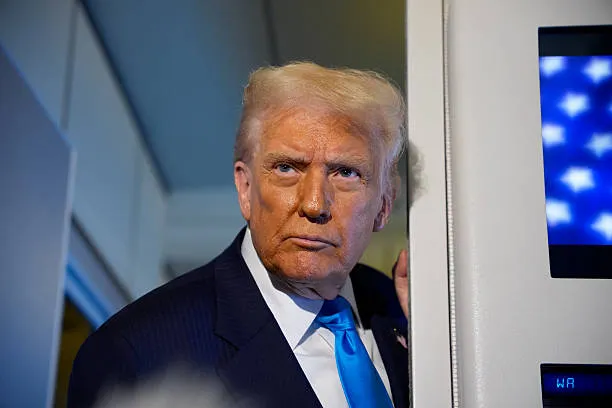
US President declares Iran “militarily defeated,” warning that any attempt to retrieve nuclear material will be met with immediate airstrikes as ceasefire talks enter a critical phase.
WASHINGTON: In a stark escalation of rhetoric amidst fragile peace negotiations, US President Donald Trump has revealed that the United States is utilizing its Space Force to maintain a 24-hour watch over Iran’s buried stockpiles of enriched uranium. The President warned that the US military is prepared to “blow up” anyone attempting to access the nuclear material, which remains trapped under the rubble of facilities destroyed in recent airstrikes.
The statement comes at a pivotal moment in the 2026 Iran conflict, as both nations exchange draft proposals via Pakistani mediators to end a war that has disrupted global energy markets and reshaped the geopolitical landscape of the Middle East.




“Space Force is Watching”
In a televised interview aired Sunday, President Trump asserted that the US has achieved significant military dominance, claiming that 70% of high-value targets in Iran have already been neutralized. He specifically highlighted the role of the US Space Force in monitoring sensitive nuclear sites, such as the Fordo enrichment complex, which was heavily damaged during “Operation Epic Fury.”
“If anyone approaches that enriched uranium, we will know it, and we will blow them up,” Trump stated, adding that US forces could eliminate all remaining targets within a two-week window if diplomacy fails.
The Diplomatic Standoff
While the President maintains a hardline stance, diplomatic channels remain active. On Sunday, Tehran submitted a new draft proposal through Pakistan, calling for:
- An immediate cessation of hostilities on all fronts.
- Guarantees against future US “aggression.”
- The lifting of the US naval blockade and sanctions on Iranian oil sales within 30 days.
- The release of billions of dollars in frozen Iranian assets.
However, the White House remains skeptical. US Secretary of State Marco Rubio emphasized that any peace deal is contingent on Iran providing verifiable proof that they have abandoned their pursuit of a nuclear weapon. “They need to make it clear that they do not seek a nuclear device,” Rubio noted, describing the buried uranium as a “major sticking point” in reaching a final agreement.
Background: A Conflict That Changed the Region
The current crisis peaked on February 28, 2026, when a joint US-Israeli operation targeted Tehran, resulting in the assassination of Supreme Leader Ali Khamenei. The strike triggered a cycle of missile and drone attacks across the region and led to an Iranian-imposed blockade of the Strait of Hormuz.
While the US declared the “combat phase” of the war concluded in early April, a heavy naval presence remains to ensure the flow of oil. Military analysts suggest that while Iran’s conventional air and naval power have been severely degraded, the presence of highly enriched uranium—estimated at over 900 pounds—continues to serve as Tehran’s final piece of leverage.
Conclusion
As the 30-day window for negotiations looms, the world remains on edge. The transition from active bombardment to a “monitored ceasefire” has provided a slight reprieve for global oil prices, but President Trump’s latest warnings serve as a reminder that the path to a lasting peace remains fraught with the threat of renewed devastation.