


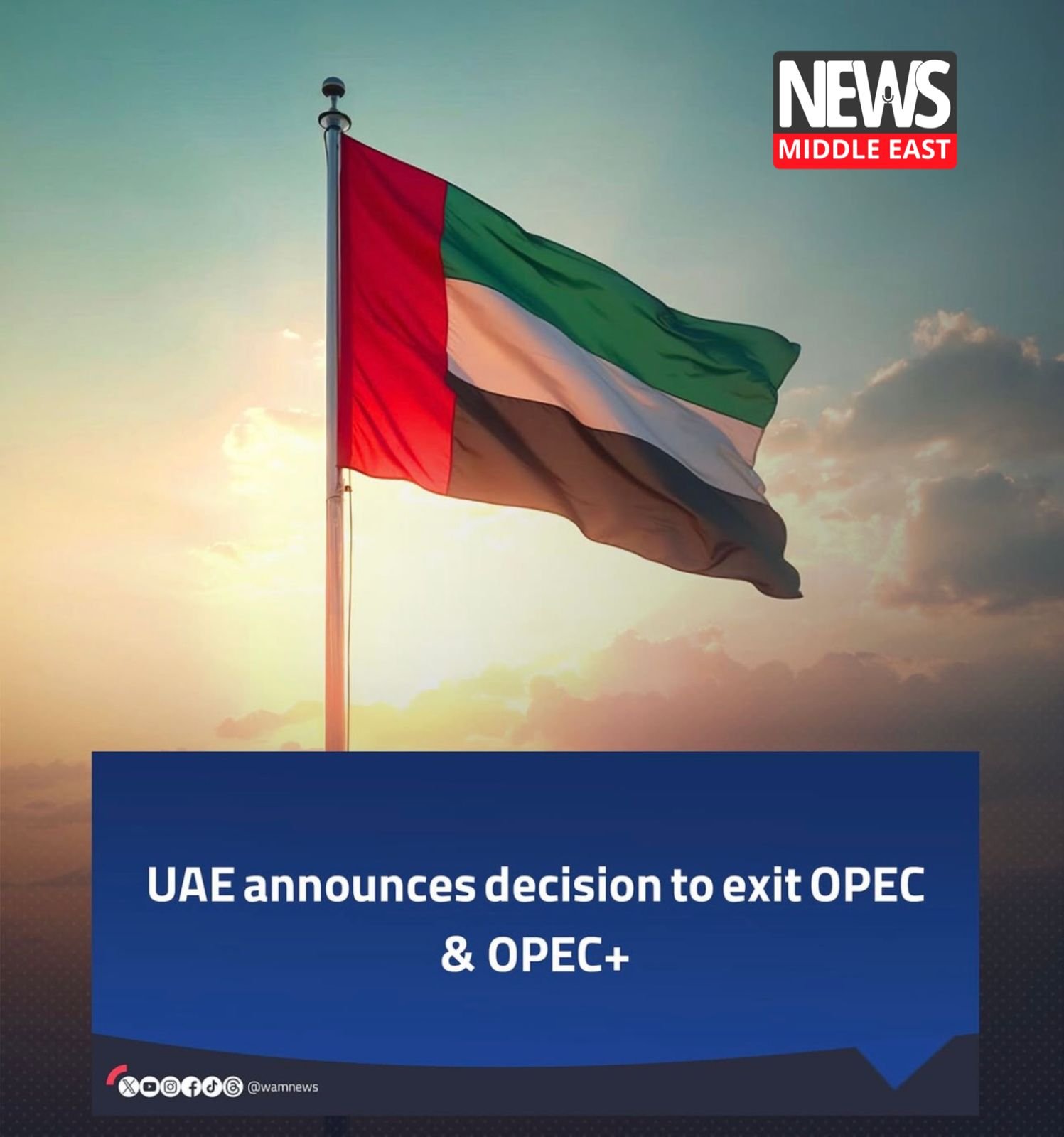
Gulf Nation Prioritizes National Economic Vision and Production Autonomy After Decades of Membership
ABU DHABI – In a move that signals a significant realignment of the global energy landscape, the United Arab Emirates (UAE) officially announced today its decision to withdraw from the Organisation of the Petroleum Exporting Countries (OPEC) and the broader OPEC+ alliance. The exit is set to take effect on May 1, 2026.
The decision marks the conclusion of a nearly 60-year partnership, as Abu Dhabi first joined the bloc in 1967, four years before the formal formation of the United Arab Emirates. Government officials stated that the withdrawal follows a comprehensive internal review of the nation’s production capacity and is designed to align with the UAE’s long-term “strategic and economic vision.”
A Policy-Driven Evolution
The UAE’s departure is rooted in its desire for greater sovereign flexibility. By exiting the quota-based system of OPEC, the UAE aims to capitalize on its massive investments in domestic energy production. The Ministry noted that the decision reflects a transition toward a “forward-looking role,” allowing the nation to meet rising global demand more efficiently while prioritizing its own national interests.



“This decision follows decades of constructive cooperation,” the official statement read, emphasizing that the move is a “policy-driven evolution” rather than a sudden rupture in diplomatic relations. The UAE intends to enhance its ability to respond to market dynamics in a “measured and responsible manner.”
Investment in Capacity and Sustainability
A key driver behind the exit is the UAE’s recent multi-billion dollar investment in increasing its production capacity. As a producer of some of the world’s most cost-competitive and lower-carbon oil barrels, the UAE views itself as a vital player in both global economic growth and the transition toward lower emissions.

While acknowledging near-term volatility—including geopolitical disruptions in the Arabian Gulf and the Strait of Hormuz—the UAE remains bullish on long-term global energy demand. The government clarified that even after the May 2026 deadline, the UAE will not flood the market. Instead, it plans to bring additional production to the market gradually, ensuring it remains a “trusted and reliable” partner to the international community.
Historical Context and Market Impact
The UAE has been a pillar of OPEC since its early years, often acting as a stabilizing force alongside Saudi Arabia. However, in recent years, friction occasionally surfaced regarding production baselines and the pace of capacity expansion. By choosing an exit date in 2026, the UAE provides the global markets and its former partners a clear window for adjustment.
Industry analysts suggest that while the exit grants the UAE the freedom to pump more oil, it also presents a challenge to OPEC’s ability to manage global prices through unified supply cuts.