


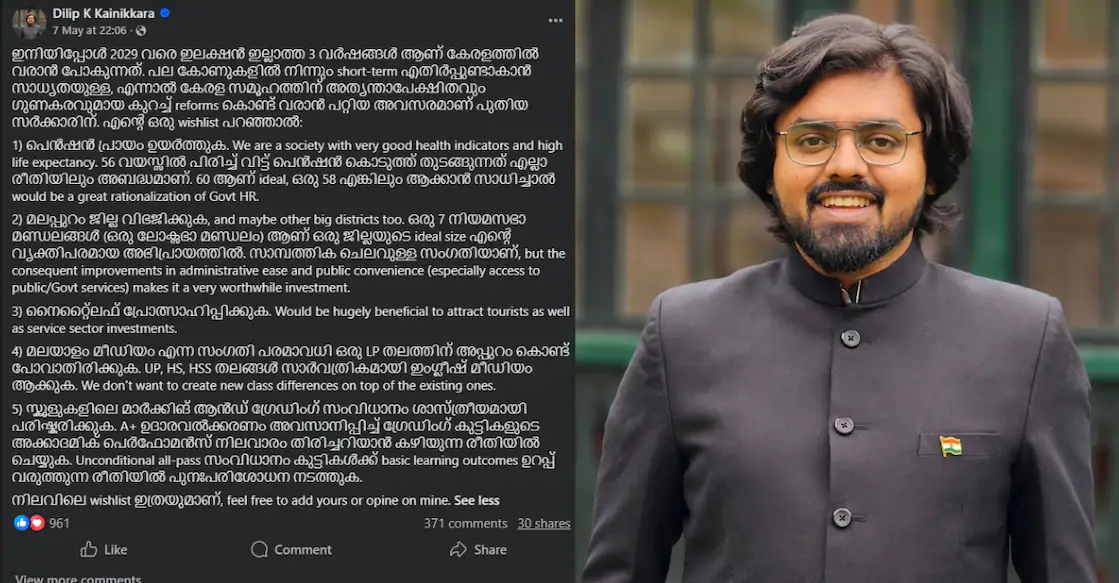

Tirur Sub Collector Dilip K. Kainikkara suggests a 60-year retirement age, English-medium universalization, and a revamp of Kerala’s administrative structure.
TIRUR: In a move that has reignited a long-standing debate in Kerala’s political and social circles, Tirur Sub Collector Dilip K. Kainikkara has proposed the bifurcation of Malappuram district. Outlining a comprehensive “reform wishlist” for the state, the official argued that structural changes are essential for better governance, suggesting that the current window before the 2029 elections offers the government a unique opportunity to implement bold policies.
The Case for Smaller Districts
Kainikkara’s primary recommendation involves the division of Malappuram and potentially other large districts to streamline administration. According to the Sub Collector, the ideal size for a district should be approximately seven Assembly constituencies—roughly the size of one Lok Sabha seat.
While acknowledging that such a move would incur significant financial costs, he emphasized that the long-term benefits would outweigh the expenditure. “The resulting improvements in administrative efficiency and public convenience, especially in accessing government services, would make it a worthwhile investment,” he noted in a recent social media post.


Aligning with Growing Demands
The proposal mirrors a persistent demand from several organizations in the region. Recently, the Muslim Youth League advocated for the creation of a new district with Tirurangadi as its headquarters. Similarly, the Samastha Kerala Jam’iyyathul Ulama (EK faction) passed a resolution citing population growth and mounting administrative challenges as reasons for an urgent reorganization of Malappuram.

Major Structural Reforms: Retirement and Education
Beyond geography, the Sub Collector’s wishlist touched upon sensitive labor and education policies:

- Retirement Age: Pointing to Kerala’s high life expectancy and superior health indicators, Kainikkara termed the current retirement age of 56 as “irrational.” He suggested 60 as the ideal age, noting that even an increase to 58 would significantly rationalize the government’s human resources and pension burden.
- English-Medium Universalization: To prevent “new class divisions,” he advocated for making English-medium education universal from the Upper Primary (UP) level onwards, limiting Malayalam-medium instruction primarily to the Lower Primary level.
- Nightlife and Tourism: To attract global investment and boost the service sector, he recommended the active promotion of nightlife in Kerala’s urban centers.
Academic Rigor
Kainikkara also criticized the current school grading system, specifically the “liberal awarding” of A+ grades. He called for a more scientific marking system that accurately reflects a student’s learning outcomes and academic merit, rather than a system that provides inflated results.
As Kerala navigates its path toward modernization, these suggestions from a high-ranking official underscore the growing consensus on the need for systemic evolution in the state’s administrative and social framework.