

Flag carrier curtails services across North America, Europe, and Asia, but commits to maintaining over 1,200 monthly global flights.
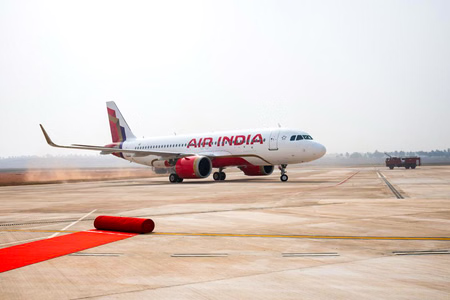
NEW DELHI — Air India has announced major, temporary reductions and suspensions across its international network effective from June until August 2026. The Tata Group-owned carrier attributed the network rationalization to record-high aviation turbine fuel (ATF) prices and ongoing international airspace restrictions, both of which have severely pressured global airline operations.
The management stated that the pre-emptive schedule overhaul is designed to enhance network stability and minimize last-minute disruptions for international travellers during a challenging operational window. Despite these strategic cuts, the airline assured passengers that it will maintain a robust global footprint, operating over 1,200 international flights every month across five continents.
Major Overhaul of North American Long-Haul Routes
The airline’s high-demand North American network faces substantial adjustments. Long-haul direct services from Delhi and Mumbai will see a mix of suspensions and reduced frequencies through the peak summer travel months:



- Suspensions: The Delhi–Chicago, Delhi–Newark, and Mumbai–New York (JFK) routes have been temporarily suspended.
- Frequency Reductions: Delhi–San Francisco flights will drop from 10 weekly services to seven. Delhi–Vancouver flights will see a reduction from seven weekly flights to five.
- Phased Adjustments: Delhi–Toronto services will be scaled back from 10 weekly flights to five through July, before restoring daily operations in August.
- Service Increase: In a strategic network reshuffle, Mumbai–Newark services will be ramped up from three weekly flights to daily operations, while Delhi–New York (JFK) will remain steady as a daily service.
European and Australian Connections Scaled Back
European routes out of New Delhi have been heavily consolidated. The airline’s prominent Delhi–Paris service is being halved from 14 weekly flights to seven.

Other key European capitals will experience moderate reductions through the summer period:
- Delhi to Copenhagen, Vienna, Zurich, and Rome: All reduced from four weekly flights to three.
- Delhi to Milan: Scaled down from five weekly services to four.
Connectivity to the Oceania region has also been adjusted. Both the Delhi–Melbourne and Delhi–Sydney routes, which previously enjoyed daily frequencies, have been scaled back to four weekly flights each.
Extensive Cuts Across Asian and South Asian Networks
For the global audience and regional commuters, services connecting major Asian commercial hubs and tourist destinations have been significantly trimmed.
East & Southeast Asia
- Suspensions: Delhi–Shanghai and Chennai–Singapore routes will remain completely suspended through August 2026.
- Singapore & Bangkok: Delhi–Singapore flights drop from 24 to 14 weekly, while Mumbai–Singapore is halved to seven weekly flights. From July, Delhi–Bangkok scales down to 21 weekly flights (from 28), and Mumbai–Bangkok drops to seven weekly flights.
- Kuala Lumpur & Vietnam: Delhi–Kuala Lumpur services are halved to five weekly flights. Services from Delhi to both Ho Chi Minh City and Hanoi are trimmed to four weekly flights for July and August.
SAARC Region
- Suspensions: Delhi–Malé (Maldives) and Mumbai–Dhaka operations are entirely suspended through August.
- Kathmandu & Bangladesh: The high-frequency Delhi–Kathmandu corridor will see a steep drop from 42 weekly flights to 28 in June, falling further to 21 weekly flights in July and August. Delhi–Dhaka services will operate four times a week instead of seven.
- Sri Lanka: Mumbai–Colombo drops to four weekly flights, while Delhi–Colombo is trimmed slightly to 12 weekly flights.
Compensation, Refunds, and Future Outlook
Air India has initiated a comprehensive customer support protocol to manage the passenger fallout. Affected travelers will be offered alternative routing options wherever feasible. Passengers also hold the right to opt for complimentary date changes or secure full financial refunds, depending on their original booking terms. The airline’s 24×7 contact centres and digital helpdesks have been reinforced to handle passenger grievances.
The airline noted that it is working closely with international civil aviation regulators, airport authorities, and alliance partners to restore its full operational capacity as soon as macroeconomic factors stabilize. However, Air India explicitly warned that further network adjustments could be introduced if jet fuel prices and airspace bottlenecks persist beyond August 2026.