

While the saffron party celebrates a “paradigm shift,” data suggests weak Congress candidates and localized anti-incumbency paved the way.
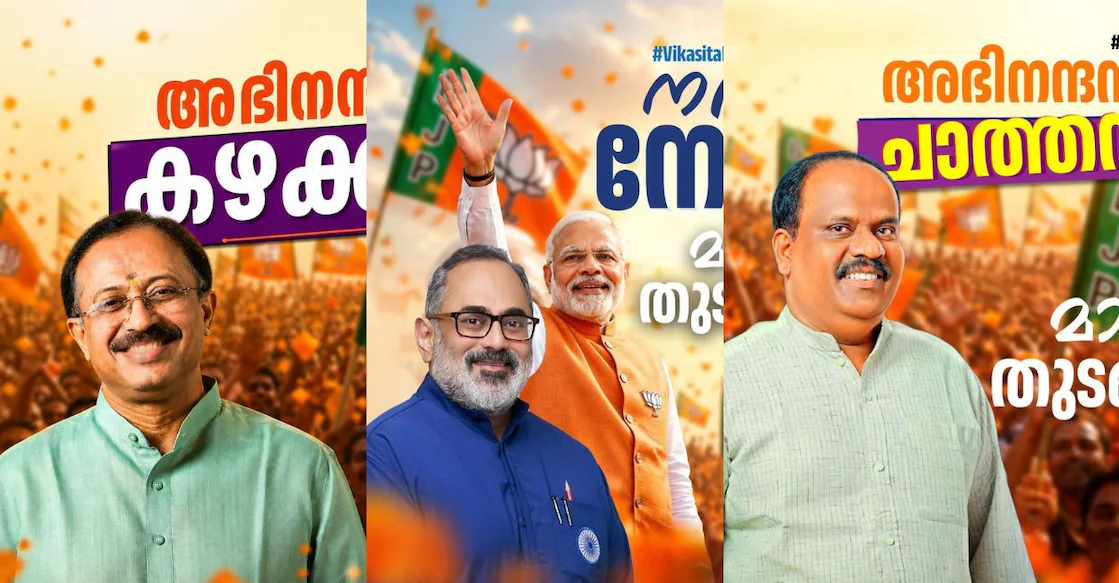
KOCHI – The political landscape of Kerala, traditionally defined by the oscillating dominance of the LDF and UDF, has undergone a structural shift in the 2026 Assembly polls. After being shut out of the state legislature in 2021, the Bharatiya Janata Party (BJP) has staged a historic comeback, securing three seats: Nemom, Kazhakoottam, and Chathannoor.
While the NDA celebrates this as a definitive ideological expansion, political analysts and local data suggest a more complex narrative. The results raise a stinging question for the Congress-led UDF: Did their choice of “weak” candidates provide the BJP with the golden ladder it needed to breach the Kerala Assembly?

The Triple Crown: How the Seats Were Won
In the three winning constituencies, the BJP’s persistence over the last decade finally hit a tipping point. By consistently finishing as the runner-up, the party successfully branded itself as the primary challenger to the Left, effectively pushing the Congress into a distant third.


1. Chathannoor: The Decade-Long Climb
In Chathannoor, B.B. Gopakumar ended a ten-year wait, defeating the CPI’s R. Rajendran by a margin of 4,398 votes. Gopakumar’s victory was a masterclass in persistence; having maintained a solid second place for two terms, he convinced voters that he was a winnable alternative.

- The UDF Factor: The collapse of the Congress base was the primary catalyst. Traditional anti-LDF voters, seeing the UDF’s Sooraj Ravi fail to mount a credible challenge, shifted en masse to the BJP to ensure the CPI’s defeat.
2. Nemom: The Capital’s Saffron Return
BJP State President Rajeev Chandrasekhar wrested Nemom back from the LDF’s V. Sivankutty with a margin of 4,978 votes. The BJP capitalized on its strong showing in the 2025 local body polls and Chandrasekhar’s high-profile campaign centered on development.
- The UDF Factor: In 2021, K. Muraleedharan (UDF) secured 25% of the vote, which ironically helped the LDF win by splitting the anti-Left vote. In 2026, the UDF’s K.S. Sabarinadhan could not hold that ground. Without a strong Congress anchor, the contest became a bipolar fight, allowing the BJP to consolidate urban anti-incumbency.
3. Kazhakoottam: A Razor-Thin Victory
In a photo-finish, V. Muraleedharan unseated former minister Kadakampally Surendran by just 428 votes. The BJP leaned heavily on the “faith” sentiment surrounding Sabarimala and allegations of gold smuggling to target the sitting MLA.
- The UDF Factor: The UDF candidate, T. Sarath Chandra Prasad, failed to sway the anti-incumbency sentiment that the UDF captured elsewhere in the state. This resulted in a three-way split of votes that ultimately favored the BJP’s disciplined booth-level mobilization.
A Surge or a Localized Phenomenon?
Despite the headlines, the state-wide data offers a sobering reality for the NDA. The party’s overall vote share grew only marginally—from 11.3% to 11.42%. Surprisingly, the BJP actually slipped in several former strongholds:
- Manjeshwar: Vote share dipped from 37.70% to 36.05%.
- Palakkad: Despite fielding Sobha Surendran, the share fell from 35.34% to 33.33% as the UDF’s Ramesh Pisharody surged.
- Kasaragod & Vattiyoorkavu: Both saw declines in vote share, with the BJP even losing its runner-up status in Vattiyoorkavu to the UDF.
Conclusion: The “Perfect Storm”
The 2026 results suggest that the BJP’s breakthrough was not a state-wide “wave” but a result of strategic patience meeting a weakened opposition. In the pockets where they won, the BJP had already established itself as the “real” opposition. When the UDF failed to field heavyweights in these strategic battlegrounds, voters frustrated with the Pinarayi Vijayan government viewed the BJP as the only effective tool to deliver a blow to the Left.
For the BJP, the challenge remains translating these localized victories into a broader state-wide acceptance. For the Congress, the post-mortem will undoubtedly focus on whether their tactical errors in candidate selection handed the BJP its most significant victory in Kerala’s history.