

Indian Board Aligns Curriculum with NEP 2020; Third Language to Face Internal Evaluation Only with No Board Exam Pressure
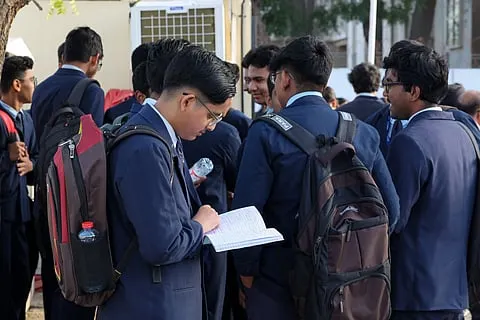
DUBAI — The Central Board of Secondary Education (CBSE) has announced a sweeping overhaul of its language policy for Classes 9 and 10, set to take effect from the 2026–27 academic year. Starting July 1, 2026, students entering Class 9 will be required to study three languages under a newly structured framework (R1, R2, and R3). Crucially for the vast diaspora in the Gulf, the mandate stipulates that at least two of these three choices must be native Indian languages, a directive aimed at strengthening multilingual roots in alignment with India’s National Education Policy (NEP) 2020 and the National Curriculum Framework for School Education (NCF-SE) 2023.
The announcement has triggered intense discussion among the Global and Gulf Malayali communities, whose children comprise a significant demographic within the UAE’s extensive network of Indian curriculum schools. Recognizing the unique challenges faced by expatriate students, the Board has embedded critical exemptions and transitionary relaxations into the policy specifically targeting overseas institutions.
No External Board Exam Pressure for Third Language
In a bid to reassure anxious parents and students, the CBSE emphasized that the revised framework is designed to foster “joyful and meaningful language learning” rather than pile on academic stress. The Board explicitly clarified that there will be no external Class 10 Board examination conducted for the newly introduced third language (R3).



Instead, the third language will be assessed entirely via internal, school-based evaluations. While passing the subject remains a mandatory requirement, the CBSE confirmed that a student’s eligibility to sit for the main Class 10 Board examinations will not be blocked, regardless of their final performance level in the R3 tier. Performance grades will be recorded on the final certificate, but the evaluation mechanism will remain strictly institutional.
Major Relief: Exemptions for UAE and Foreign-Return Students
The circular offers substantial regulatory relief for international hubs like the UAE. CBSE confirmed that schools located outside India are eligible for applicable exemptions under the new policy. Furthermore, foreign-born students or those returning to India from overseas schools may be considered for case-by-case exemptions from the baseline rule requiring two native Indian languages.
Additionally, Children with Special Needs (CwSN) will continue to receive robust relaxations under the Rights of Persons with Disabilities (RPwD) Act, 2016, which includes complete exemptions from second or third language requirements where applicable.
For students keen on pursuing foreign languages (such as French, German, or Arabic), the policy permits them either as the third language—provided the first two are native Indian languages—or as an optional fourth language.
Managing the Transition: Textbooks and Staffing Adjustments
Acknowledging that schools may initially struggle to secure qualified educators for diverse Indian languages, the CBSE has permitted flexible staffing models. During this transitionary phase, schools can utilize shared teachers, hire retired faculty, deploy trained postgraduates, or adopt hybrid learning systems.
To bridge the immediate resource gap, a temporary textbook arrangement has been established for the 2026–27 academic year. Until dedicated secondary-level curricula are finalized, Class 9 students will utilize Class 6-level textbooks for their chosen R3 language. Schools are also encouraged to supplement classrooms with regional literary materials, including local poems, short stories, and non-fiction.
The CBSE has committed to supplying textbooks for 19 scheduled Indian languages before July 1, 2026, while allowing schools to leverage SCERT or state-level resources for any remaining regional languages.
Implementation Timeline
The administrative rollout is already underway. The CBSE has instructed all schools to update their third-language offerings for Classes 6 to 9 on the official OASIS portal by June 30, 2026. Comprehensive teaching guidelines, sample question papers, and internal assessment rubrics are expected to be officially released by the Board on or before June 15, 2026, ensuring institutions have a clear roadmap before the new academic cycle commences.