

Land-Route via Oman Border Emerges as Crucial Logistics Artery to Bypass Maritime Delays, Moving Over Dh8 Billion in Cargo
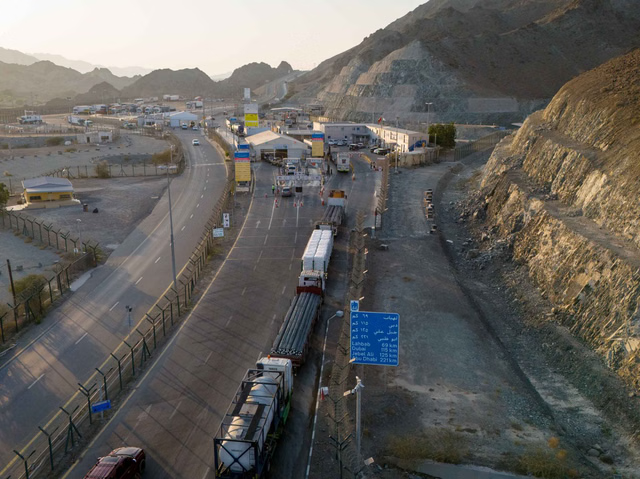
DUBAI — In a swift response to rising maritime vulnerabilities, Dubai Customs’ “Green Corridor” initiative has rapidly evolved from an emergency trade facilitation measure into one of the Gulf region’s most critical land-based logistics routes. Initially activated in March 2026 to counter unprecedented disruptions across traditional shipping channels, the expedited land route via the Hatta Border Crossing has successfully safeguarded the flow of global supply chains into the UAE and wider markets.
The initiative, operationalized within a mere 72 hours of its conception in cooperation with Oman Customs, allows containers bound for Jebel Ali Port, Dubai’s domestic market, and international re-export hubs to bypass volatile sea lanes. Under constant customs supervision, shipments arriving at Omani ports are seamlessly redirected overland, effectively insulating businesses from escalating freight fees, port congestion, and soaring maritime insurance costs.

A Striking Surge in Trade Volumes
The strategic pivot from sea to land is vividly reflected in recent trade data. Dubai Customs reported that monthly customs declarations processed through the Green Corridor skyrocketed from approximately 12,000 in March to nearly 100,000 in April 2026.



Concurrently, the total value of goods secured and transported via this land route—including insurance and freight costs—surged from Dh1 billion to over Dh8 billion within the same 30-day window. This exponential growth underscores the agility of global logistics providers, who rapidly rerouted supply lines once a dependable, hassle-free alternative became available.
Digital Precision and Seamless Operations
The operational framework of the Green Corridor blends advanced digital integration with stringent physical security. Cargo is transported across the border in sealed trucks monitored continuously by customs authorities.
+--------------------------------------------------------------------------+
|                      GREEN CORRIDOR OPERATIONAL FLOW                      |
+--------------------------------------------------------------------------+
|  [Advance Data Processing] -> Pre-arrival manifests & digital clearance  |
|                                     v                                    |
|  [Secure Land Transit]     -> Sealed trucks under constant monitoring   |
|                                     v                                    |
|  [Flexible Port Inflow]    -> Expanded to Fujairah & Khorfakkan ports   |
+--------------------------------------------------------------------------+
By leveraging advanced digital systems, customs personnel process pre-arrival cargo data, manifests, and bills of lading before the physical shipments reach the Hatta border. This proactive verification accelerates inspection and clearance times without compromising security protocols.
To offer businesses greater commercial breathing room amid unpredictable regional schedules, Dubai Customs has also extended the allowable transit period for goods from 30 days to 90 days. This buffer enables free-zone operators and retailers to optimize warehousing and manage inventory without facing administrative bottlenecks.
Expanding the Logistics Network
Recognizing the broader need for trade diversification, Dubai Customs has extended similar facilitation measures to shipments entering through the UAE’s eastern gateway ports of Fujairah and Khorfakkan. Containers landing at these ports can now be transitioned directly overland to Dubai without undergoing standard, lengthy customs clearances at the initial point of entry. This tactical modification drastically minimizes cargo dwell times and provides a crucial safety valve for the region’s supply chain ecosystem.
Reinforcing Dubai’s Economic Resilience
Beyond immediate logistics management, the Green Corridor serves as a testament to Dubai’s long-term economic resilience. As a primary global re-export hub bridging trade between Asia, Europe, Africa, and the Middle East, maintaining uninterrupted trade flows is vital to the emirate’s economic blueprint.
“The initiative reflects Dubai’s proactive and flexible approach to managing regional and international developments while supporting business continuity and economic sustainability,” stated Dr. Abdulla Busenad, Director General of Dubai Customs. He emphasized that close cooperation with strategic private-sector partners remains central to maintaining global business confidence.
As international trade corridors face ongoing volatility, the rapid success of the Green Corridor highlights a profound shift in global logistics. Supply chain resilience, route diversification, and cross-border digital alignment are no longer just contingency plans—they are the foundational pillars of future global commerce.