



Baghdad forms special committee to probe drone strikes and pledges to restrict all weapons to state authority
DUBAI: The Iraqi government has firmly reiterated its absolute rejection of any attempts to use its territory or airspace as a launchpad for military aggression against its neighbors, specifically naming the United Arab Emirates (UAE) and Saudi Arabia. Following a high-level security meeting, Baghdad pledged to take decisive legal and operational action against any individuals or factions attempting to compromise regional stability or breach the country’s sovereign commitments.
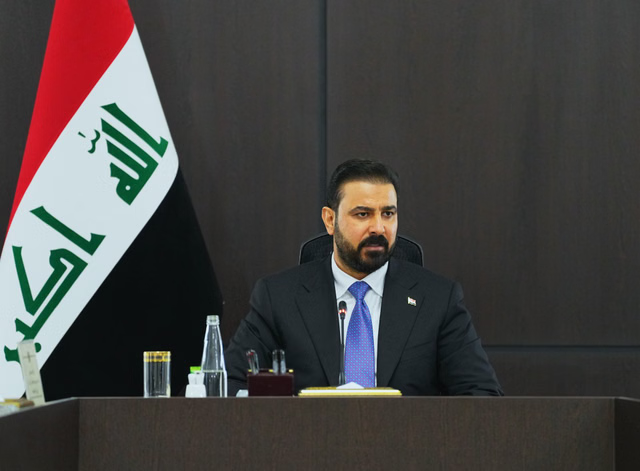
The diplomatic and security response followed a Ministerial Council for National Security meeting chaired by Iraqi Prime Minister and Commander-in-Chief of the Armed Forces, Ali Faleh Al Zaidi. The session, convened to review national security readiness and coordination among state forces, heavily focused on the geopolitical fallout from recent hostile cross-border operations.
Investigations and Regional Cooperation
In an official statement released by the Prime Minister’s Office, the Council renewed its strict condemnation of recent cross-border drone strikes directed at civilian and critical economic infrastructure in the Gulf Cooperation Council (GCC) area. To address the situation, the government has established a dedicated committee tasked with directly coordinating tracking data and intelligence with relevant authorities in both Abu Dhabi and Riyadh.


Prime Minister Al Zaidi explicitly directed state security intelligence agencies to systematically track down those responsible. The executive decree mandates immediate, firm intervention should finalized technical tracking confirm that elements within Iraqi borders acted as a launch point for these unauthorized cross-border provocations.
UAE Condemnation of Barakah Nuclear Plant Strike
The Iraqi security declaration coincides with a sharp diplomatic response from the UAE Ministry of Foreign Affairs (MoFA). Emirati authorities issued a formal condemnation following a Sunday drone breach that targeted the Barakah Nuclear Energy Plant in the Al Dhafra region. According to official reports, while UAE air defense systems successfully engaged incoming threats, one hostile drone managed to strike an external electricity generator located outside the highly secured inner perimeter of the peaceful nuclear facility.
Emirati diplomats strongly denounced the operation, labeling it a flagrant violation of state sovereignty, international humanitarian law, and the UN Charter. The UAE Ministry urged Baghdad to actively fulfill its regional obligations, calling for immediate, unconditional actions to curb hostile acts originating from within its borders. Concurrently, Abu Dhabi emphasized that a stable, sovereign Iraq remains a vital partner for broader Middle East stability.


Broader Security Reforms
As part of an overarching domestic stabilization strategy, the Iraqi government reaffirmed that it will tolerate zero interference from armed factions or independent cells seeking to endanger foreign diplomatic missions or international corporations operating inside the country.
Central to Prime Minister Al Zaidi’s agenda is a rigorous push to enforce state-wide security reforms, with the Council reiterating its policy to strictly restrict all weapons and military hardware exclusively to state-sanctioned military and police forces.