


Governor’s Dismissal Powers Under Article 164 Loom as TMC Refuses to Cede Power to Majority-Winning BJP
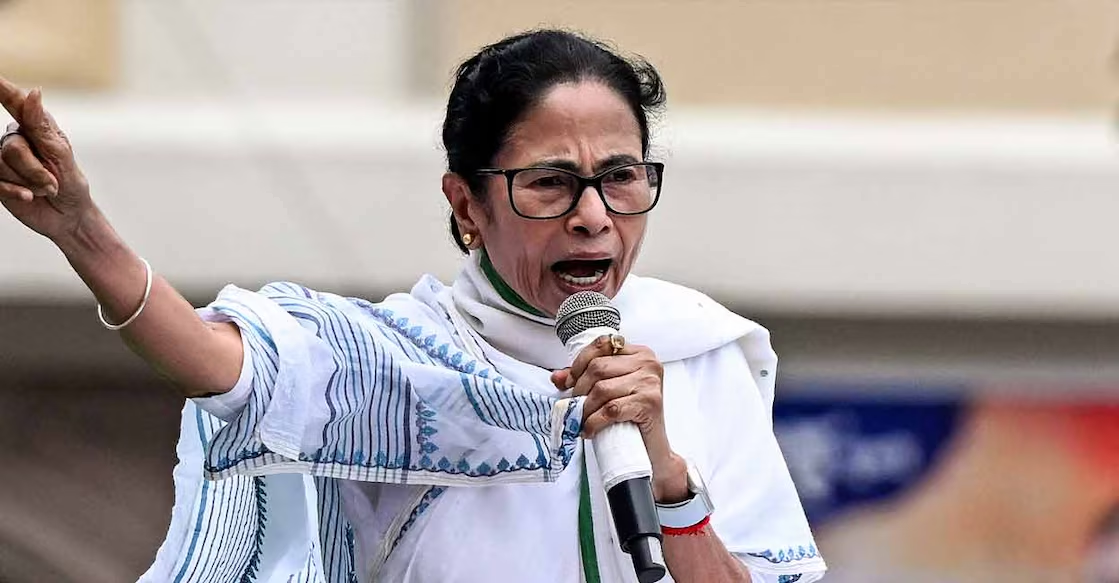
KOLKATA – West Bengal has been plunged into an unprecedented constitutional impasse following the 2026 Assembly election results. Chief Minister Mamata Banerjee has sparked a standoff by refusing to step down, despite a decisive mandate that ended the Trinamool Congress’s (TMC) 15-year tenure. The Bharatiya Janata Party (BJP) secured a commanding majority with 207 seats in the 294-member House, while the TMC was reduced to just 80 seats.
The Chief Minister’s defiance raises a critical legal question: Can an incumbent leader continue to hold office after losing the democratic mandate? According to the Indian Constitution, the answer is a firm no.
The Governor’s Mandate and Article 164
Legal experts point to Article 164 of the Indian Constitution, which stipulates that the Chief Minister and the Council of Ministers hold office during the “pleasure of the Governor.” While this “pleasure” is generally a formality, it is legally tethered to the government’s ability to command a majority in the Legislative Assembly.



Once the Election Commission formally notifies the results, a government without a majority loses its constitutional legitimacy. Should an outgoing Chief Minister fail to submit their resignation, the Governor possesses the authority to unilaterally withdraw “pleasure” and dismiss the government to facilitate the transition of power.
Precedents and the Path Forward
The Governor is not required to wait for a formal resignation to act. In the current scenario, the Governor can invite the leader of the BJP—the party with a clear majority—to form the government. This process effectively renders the incumbent administration obsolete.
The landmark S.R. Bommai vs. Union of India judgment established that the floor of the House is the only place to prove a majority. However, in the wake of a fresh general election where the numbers are transparent and certified, the transition is considered a procedural necessity rather than a matter of debate.
Restrictions on Defeated Leaders
While Article 164(4) allows a non-legislator to hold a ministerial position for up to six months, constitutional scholars argue this provision is intended for those seeking a fresh mandate, not those who have just been rejected by the electorate. Furthermore, a “caretaker” administration—should one be established—is legally barred from making major policy decisions, significant appointments, or financial commitments.

The Spectre of President’s Rule
If the TMC leadership continues to obstruct the democratic process, the state could face the imposition of Article 356. Under this provision, the Governor can recommend President’s Rule citing a breakdown of constitutional machinery. This would place West Bengal under central administration until the new government is legally sworn in.
As the stalemate continues, all eyes are on Raj Bhavan. The Governor’s next steps will determine whether West Bengal experiences a smooth transition or a protracted legal battle over the sanctity of the democratic vote.