

Defying fading eyesight, veteran painter Nazar Haidri reinvents his signature style using palette knives and deep devotion.
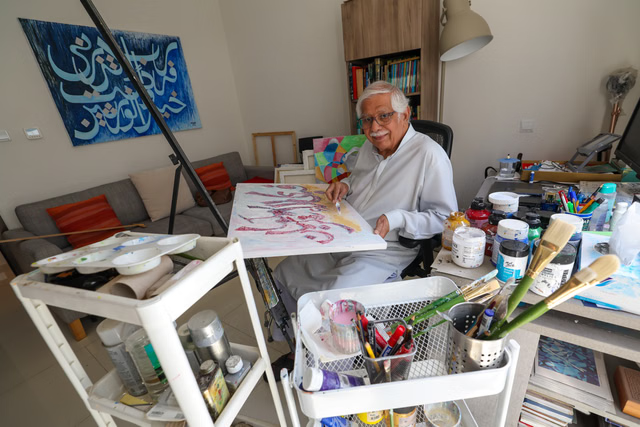
DUBAI — In a quiet, makeshift studio inside a modest Dubai apartment, 83-year-old Pakistani artist Nazar Haidri holds a canvas just inches from his face. His eyes, which spent decades capturing the intricate weight of color, now struggle against a dimming world. Yet, with a deliberate and steady hand, he drags a palette knife across the canvas, coaxing thick, vivid ridges of paint into a stunning reality.
Nazar, a resident of the UAE for the past decade, was diagnosed with a degenerative condition where his optic nerves are drying out, leaving his vision heavily blurred and softened. While such a diagnosis could signify the permanent end of a visual artist’s career, for Nazar, it has sparked a profound artistic liberation. Trading fine brushes for the expressive textures of impasto painting, he has learned to rely on feeling over precision.
“I can’t stop painting. It’s my passion,” Nazar says. “Before, I would sketch everything out, work with a brush, build up the detail carefully. That level of precision is harder for me now. So I found an alternative.”


A Golden Visa and Recognition in Retirement
Nazar’s artistic revival didn’t just happen in a vacuum; it flourished in the supportive cultural landscape of the UAE. After spending over 40 years as a marketing and advertising executive in Saudi Arabia, he retired to Dubai a decade ago to be closer to his children.
Freed from commercial deadlines, he fully dedicated himself to his canvas. His unique signature style—a rare fusion of geometric Cubism, the ancient heritage of Quranic calligraphy, and the luminous dot-work of Pointillism—quickly caught the attention of the local arts scene. Recognizing his contributions, Dubai Culture nominated him for the prestigious UAE Golden Visa.

“Dubai was the place where, in my retirement, I could pursue my passion and be recognized for it,” Nazar reflects. “This city has given me a new lease on life.”
His works have since been showcased at World Art Dubai, DIFC Art Nights, and prestigious galleries spanning Boston, London, Hong Kong, and Pakistan, commanding thousands of dollars from international collectors.
Roots in Lucknow and Karachi: Learning from Masters
To understand Nazar’s resilience, one must look back to his roots. Born in Lucknow, India—a historic cultural hub of Urdu poetry and music—he developed a childhood obsession with sketching despite coming from a traditional family that favored stable government jobs.
In 1958, he migrated to Karachi, Pakistan, where he worked at a petrol station to make ends meet. His true turning point came when he joined the Arts Council of Pakistan. There, he had the extraordinary fortune of working alongside two legendary masters of South Asian art: Sadequain, the iconic calligrapher and poet, and Zainul Abedin, the renowned Bangladeshi painter. Both masters had been commissioned to create murals for the State Bank of Pakistan, and Nazar was selected as a student assistant.
A Final Dream: Preserving a Masterpiece
Though the pandemic eventually slowed down his public gallery appearances, Nazar continues to create every single day from his home studio, swapping pencils for markers and brushes for palette knives.
As he navigates this twilight chapter of his life, Nazar holds onto one final, deeply personal ambition. Years ago, while his vision was still sharp, he executed a breathtaking piece of Quranic calligraphy capturing Surah Al-Fatihah, the opening chapter of the Quran. He considers it the magnum opus of his career.
“It is one of my proudest works. I really hope something so significant, so meaningful, can be placed in a public institution, somewhere it can not only be seen but truly appreciated,” he shares. “The goal of any artist is for their work to reach and inspire as many people as possible.”